


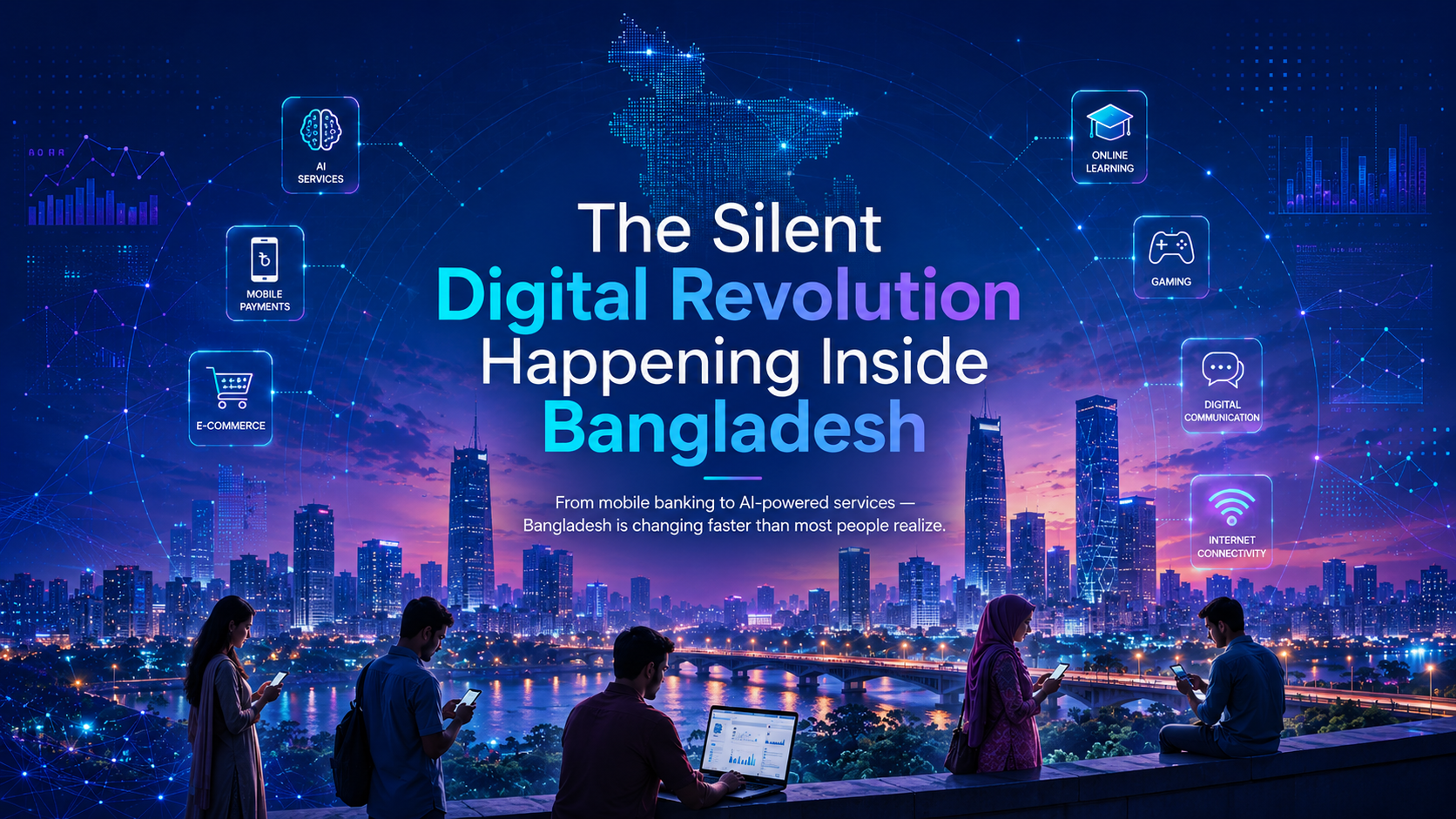
A few years ago, sending money meant visiting someone, waiting in line, or depending on a bank branch. Paying bills felt like a task. Shopping meant going to a market. Learning meant being physically present in a classroom.
Today, a student in a village watches tutorial from a smartphone. A small shopkeeper receives mobile payment. A freelancer works with a client abroad from Dhaka, Chattogram, Rajshahi, or Narayanganj. A business owner sells products through Facebook, receives payment digitally, and promotes the business online.
Bangladesh did not become digital loudly. It became digital quietly — one tap, one app, one transaction, one user at a time.
And that is the real story of the silent digital revolution happening inside Bangladesh.
- The Smartphone Became Our Everyday Control Panel
The smartphone is no longer just a communication device. For many people in Bangladesh, it has become a bank, classroom, marketplace, entertainment screen, business tool, and personal assistant.
From ordering food to checking cricket updates, from paying bills to learning a new skill — the smartphone is now deeply connected with daily life.
According to AMTOB/BTRC data, Bangladesh had 185.80 million mobile phone subscribers and 128.99 million internet subscribers at the end of January 2026. Mobile internet alone represented 114.22 million subscribers.
That means digital access is no longer limited to a small urban group. It is spreading across age groups, income groups, and regions.
What changed in daily life?
|
Before |
Now |
|
Visit bank physically |
Send money through mobile |
|
Stand in queue for bills |
Pay utility bills online |
|
Depend on TV/newspaper |
Get instant digital updates |
|
Physical shop only |
Facebook/e-commerce selling |
|
Classroom-only learning |
YouTube, apps, online courses |
This is why Bangladesh’s digital transformation is not only about technology. It is about behavioral change.
- Mobile Finance Made Digital Trust Real
For many Bangladeshis, mobile financial services were the first real experience of digital convenience.
People who never used formal banking started sending money, receiving salaries, paying bills, purchasing products, and supporting families through mobile wallets. This created a new kind of trust in digital services.
The big shift was simple: people realized that a digital transaction could be fast, reliable, and useful. Today, digital payment is visible almost everywhere:
- Local shops
- Ride-sharing services
- E-commerce platforms
- Freelance payments
- Subscription services
- Utility bill payments
- Merchant transactions
This shift helped Bangladesh move toward financial inclusion. More importantly, it changed the mindset of users. People started asking:
“Why should I wait if I can do it instantly?”
- Learning, Shopping, Entertainment — Everything Moved Closer
The digital revolution became powerful because it entered simple parts of life.
A student can learn from YouTube. A parent can check school updates through messaging apps. A small business can promote products on Facebook. A young gamer can join online tournaments. A buyer can compare prices before visiting a shop.
DataReportal’s Digital 2026 report states that Bangladesh had 82.8 million internet users at the end of 2025, with internet users increasing by 5.3 million between October 2024 and October 2025. It also reported 64.0 million social media user identities in October 2025.
That growth is not just a number. It means more people are reading, watching, buying, selling, learning, and communicating digitally.
The most visible changes
- Education: Online tutorials, skill courses, digital classrooms
- Commerce: Facebook shops, e-commerce platforms, digital payments
- Entertainment: OTT, gaming, live streaming, short videos
- Work: Remote collaboration, freelancing, digital productivity tools
- Communication: Messaging apps, video calls, online communities
This is how technology becomes powerful: not when people talk about it, but when people use it without thinking.
- AI and Gaming Are Creating a New Digital Culture
Artificial Intelligence may sound futuristic, but most users already experience AI every day.
When Facebook recommends content, YouTube suggests a video, Google Maps predicts traffic, or a chatbot answers a question — AI is already working behind the screen.
For businesses, AI is becoming more practical. It can help with customer support, sales analysis, marketing content, HR screening, fraud monitoring, document processing, and decision-making.
At the same time, gaming is creating another digital culture in Bangladesh. Mobile games, sports prediction, esports-style engagement, tournament models, and reward-based platforms are attracting young users.
This matter because gaming is no longer only “play.” It is becoming:
- A community
- A content format
- A marketing channel
- A youth engagement tool
- A potential digital economy
For a young country like Bangladesh, this is important. Youth behavior often shows where the market is moving next.
- Businesses Must Catch Up with the New Customer
The Bangladeshi customer has changed.
Today’s users expect fast service, easy payment, simple app navigation, instant response, and personalized communication. If a service feels slow or confusing, users quickly move to alternatives.
This is where many companies face a serious challenge.
- They may have good products, but weak digital experience.
- They may have strong operations, but poor customer data.
- They may have loyal customers, but no digital engagement strategy.
The next phase of competition will not depend only on price. It will depend on experience.
Businesses now need to think about:
- Is our service available digitally?
- Can customers complete tasks easily?
- Are we using data to understand users?
- Do we have digital payment options?
- Can we respond to customers quickly?
- Are we ready for AI-assisted operations?
- Is our product built for Bangladesh’s real users?
Digital transformation is no longer a “nice to have.” For many businesses, it is becoming a survival strategy.
- The Revolution Is Real, But Not Complete
Bangladesh’s digital progress is impressive, but the journey is still unfinished.
Many people are online, but many still lack proper digital literacy. Many users make digital payments, but fraud awareness is still low. Businesses are adopting apps and platforms, but cybersecurity and data protection are not always strong enough.
DataReportal also notes that although Bangladesh had 82.8 million internet users at the end of 2025, around 93.4 million people remained offline at that time.
So, the next challenge is not only bringing more people online. The real challenge is making digital services:
- Safer
- Simpler
- More inclusive
- More reliable
- More locally relevant
Technology must work for real people — not just for reports, dashboards, or urban users.
- The Next Bangladesh Will Be Built by People + Technology
The most exciting part is that Bangladesh’s digital story is still at an early stage.
The next few years may bring stronger AI adoption, better fintech solutions, smarter public services, digital healthcare, local language platforms, secure identity verification, online learning ecosystems, and more youth-led digital businesses. But technology alone will not build the future. People will.
- The shopkeeper who accepts digital payment.
- The student who learns online.
- The entrepreneur who starts from a Facebook page.
- The freelancer who earns globally.
- The company that improves customer experience through technology.
- The young innovator who builds a product for Bangladesh.
Final Thought
The silent digital revolution is not happening inside data centers only. It is happening inside homes, shops, classrooms, offices, roads, markets, and smartphones. It is happening when people choose:
- convenience over complexity.
- Speed over waiting.
- Digital access over physical barriers.
- Innovation over old habits.
Bangladesh did not become digital in one day. But every day, it is becoming more digital than yesterday. And perhaps that is the most powerful revolution of all — the one we are already living in.
Miaki Closing Note
At Miaki, we believe Bangladesh’s digital future will be built through practical innovation, user-friendly technology, scalable platforms, and meaningful digital experiences.
Because technology is not only about systems. It is about people, behavior, trust, and the possibilities we create together.