


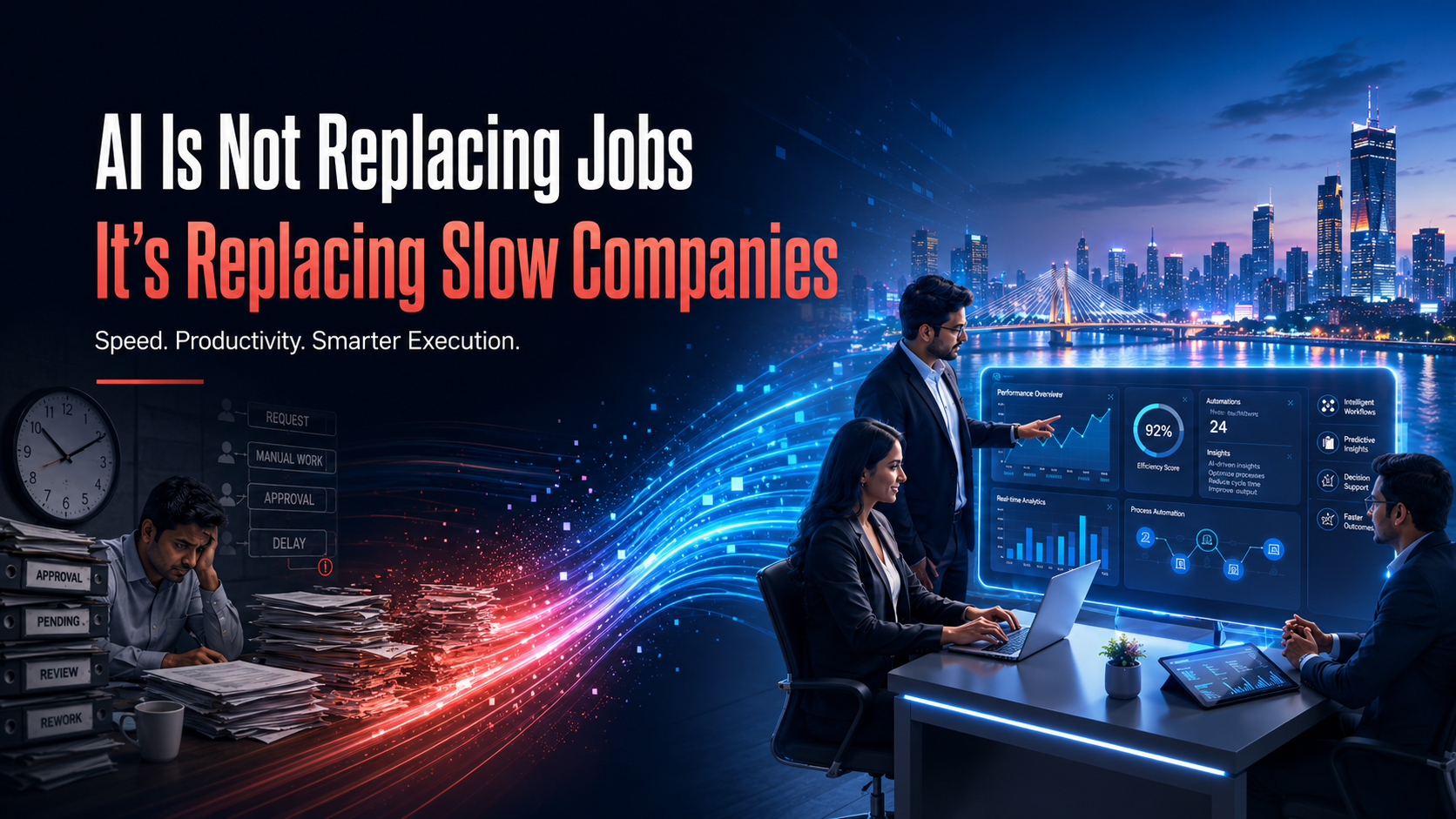
The real competitive advantage of AI is not fewer people. It is faster decisions, leaner operations, stronger customer experiences, and teams that can execute before the market moves on.
MIAKI Thought Leadership • 5-minute read • Bangladesh business perspective
|
“The real threat is not that AI will replace every employee. It is that a faster, AI-enabled competitor will serve the same customer better, sooner, and at lower cost.” |
For years, the loudest conversation around artificial intelligence has been about job loss. It is an understandable concern. AI can now write, summarize, translate, analyse, generate designs, support customers, and automate routine tasks that once required hours of human effort.
But inside real businesses, a different story is unfolding. AI is not simply replacing people. It is replacing delay: slow reporting, repeated data entry, manual follow-ups, fragmented customer service, and decisions made after the opportunity has already passed.
The companies most exposed are those that remain slow while customers, competitors, and markets become faster.
Bangladesh’s Customers Have Already Moved Faster
Bangladesh is now a deeply mobile and increasingly digital market. DataReportal’s Digital 2026 report estimates that the country had 82.8 million internet users in late 2025 and 186 million active cellular mobile connections. Customers may not use the term “AI transformation,” but they already expect instant confirmation, easy onboarding, quick support, clear updates, and personalised service.
That expectation is visible across mobile financial services, telecom, e-commerce, digital entertainment, logistics, education, healthcare, and app-based services. A customer who can complete a payment in seconds will not accept a three-day response to a basic service request. A business buyer who receives one proposal today may not wait a week for another.
The external market is now moving faster than many internal processes.
AI Changes Tasks Before It Changes Entire Jobs
Most jobs are bundles of different activities. Some require judgement, empathy, negotiation, accountability, or deep domain knowledge. Others are repetitive, rules-based, and time-consuming. AI usually enters through those repetitive activities first.
- A customer support officer uses AI to classify tickets, retrieve the right policy, and prepare a first response.
- A business development team uses AI to research prospects and structure a proposal, then applies human judgement to the commercial offer.
- A finance team uses automated alerts to identify unusual transactions instead of reviewing every record manually.
- A product team analyses thousands of user comments to identify recurring pain points and prioritise the next release.
The human role does not disappear. It moves upward—from producing every first draft to reviewing, deciding, improving, and taking responsibility for the result.
The New Competition Is Business Speed
Speed does not mean rushing or reducing quality. It means removing avoidable waiting time between information and action. In an AI-speed economy, companies compete on how quickly they can understand a signal, make a decision, and deliver a useful response.
|
Business Area |
Traditional Friction |
AI-Enabled Advantage |
|
Customer service |
Manual sorting and repeated replies |
Faster routing, suggested responses, 24/7 self-service |
|
Sales & BD |
Slow research and proposal preparation |
Rapid insight, tailored drafts, better follow-up |
|
Operations |
Reports compiled after problems occur |
Live alerts, summaries, exception-based action |
|
Marketing |
One campaign takes days to prepare |
Faster concepts, variants, testing, and localisation |
|
Management |
Decisions wait for multiple spreadsheets |
Clearer dashboards and quicker scenario analysis |
McKinsey estimates that generative AI could add between US$2.6 trillion and US$4.4 trillion in annual economic value across analysed corporate use cases. The number is global, but the message is local: productivity gains will come from redesigning work, not merely purchasing a tool.
What This Looks Like in Bangladesh
For a Bangladeshi SME, AI may begin with faster quotations, social media responses, inventory alerts, or a simple customer-service assistant. For a telecom operator, it may support churn prediction, campaign personalisation, complaint prioritisation, and smarter value-added-service recommendations.
In fintech, practical use cases include document review, fraud pattern detection, support-ticket classification, and risk alerts. A service company can reduce proposal turnaround time, search internal knowledge faster, and automate routine progress updates. A startup can analyse feedback, test product ideas, and launch a sharper minimum viable product with a smaller team.
The common thread is enabling capable people to spend less time on repetition and more time on customers, strategy, quality, and growth.
AI Cannot Repair a Broken Process by Itself
There is also a warning. If a company has unclear ownership, poor-quality data, scattered documents, and unnecessary approval layers, adding AI may only accelerate the confusion. Technology amplifies the process it is placed inside—good or bad.
Before investing, leaders should identify where the organisation is actually losing speed:
- Where do customers wait unnecessarily?
- Which task is repeated every day with little variation?
- Which report arrives too late to influence a decision?
- Where do employees search for information that should be easy to find?
- Which approval exists only because the workflow was never redesigned?
The strongest AI initiative starts with a measurable business problem: reduce response time, lower errors, improve conversion, shorten processing time, or increase service capacity.
The Human Advantage Becomes More Valuable
AI can generate options, but people define the objective. AI can identify patterns, but experienced teams understand context. AI can prepare a recommendation, but leaders remain responsible for the decision.
The World Economic Forum’s Future of Jobs Report 2025 finds that AI and information-processing technologies are among the strongest forces reshaping work. It also reports that nearly 40% of skills required on the job are expected to change by 2030. Technical capability will matter, but so will creative thinking, resilience, judgement, collaboration, and communication.
The future therefore is not “human versus AI.” It is capable people using AI responsibly versus teams that continue to work with slower methods.
A Practical Starting Point for Business Leaders
AI adoption should be treated as an operating-model decision, not a one-time software purchase. A focused pilot can create more value than a large transformation programme with no clear owner or metric.
- Select one high-friction workflow. Choose a process with visible delay, repetitive effort, or frequent customer complaints.
- Define the business measure. Track response time, processing cost, error rate, conversion, service capacity, or customer satisfaction.
- Keep people in control. Use human review for financial, legal, HR, compliance, and customer-sensitive decisions.
- Train teams, not only systems. Employees need practical guidance on prompting, verification, data privacy, and responsible use.
- Scale what proves useful. Once the pilot works, connect it with CRM, ERP, support platforms, dashboards, apps, or enterprise workflows.
The Companies That Adapt Will Set the Pace
AI is not a substitute for leadership, customer understanding, process discipline, or a strong team. But it is a powerful accelerator for organisations that already know what they are trying to improve.
It accelerates research, service, reporting, communication, product improvement, and decision-making. That acceleration compounds: a faster insight creates a faster action; a faster action creates a better customer experience; and a better experience creates stronger trust and growth.
The real risk is not that every job will disappear. The real risk is that companies will keep talented people trapped inside slow systems while competitors give their teams better tools, clearer data, and faster ways to execute.
AI is replacing repetitive inefficiency. It is replacing delayed decisions. And, increasingly, it is replacing companies that refuse to adapt.
A MIAKI Perspective
At MIAKI, we believe technology creates value when it solves a real operational or customer problem. Our focus is on practical innovation, scalable digital platforms, AI-enabled thinking, and enterprise solutions that help organisations move faster without losing control, quality, or human judgement.
For Bangladesh’s businesses, the AI-speed economy is not about following hype. It is about building the ability to respond sooner, execute smarter, and serve customers better.