


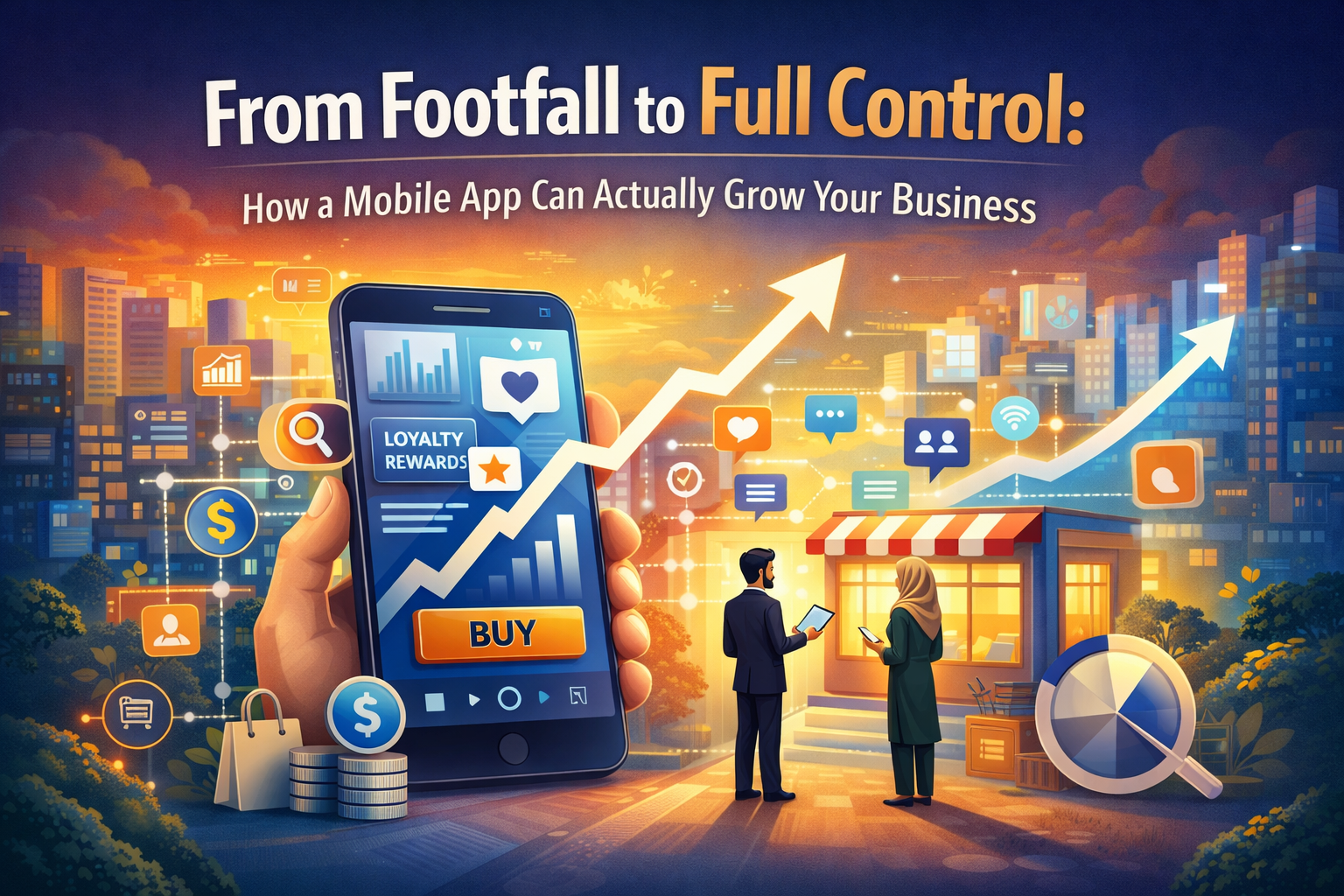
How a Mobile App Can Actually Grow Your Business
It Looks Like Growth… But Is It?
On any given day, your business might look busy. Customers walk in, orders are processed, and revenue is generated. From the outside, everything feels right — activity equals success.
But real growth is not measured by how busy you are today. It is measured by how predictable, repeatable, and scalable your revenue is over time.
Most businesses operate in a cycle where each day starts from zero. There is no continuity between yesterday’s customers and tomorrow’s revenue. Transactions happen, but relationships don’t.
Behind this surface-level success, a deeper gap exists:
- No structured customer tracking
- No understanding of user behavior
- No system to bring customers back
The business is active — but not evolving.
The Silent Growth Problem
Many businesses unknowingly operate without a growth system. They rely heavily on new customer acquisition while ignoring the value of existing customers.
This creates a situation where growth becomes unstable and expensive. Marketing efforts increase, but retention remains weak. As a result, revenue becomes inconsistent.
At its core, the issue is not lack of effort — it is lack of structure.
This leads to several hidden challenges:
- High dependency on footfall and visibility
- Increasing marketing costs with limited ROI
- Weak customer loyalty and repeat engagement
Revenue becomes reactive instead of strategic.
What the Numbers Reveal
When we analyze business performance across industries, one insight consistently stands out: retention drives growth more than acquisition.
Businesses that grow sustainably are those that understand and engage their existing customers effectively.
Key data-backed insights include:
🔹 Up to 80% of revenue comes from repeat customers
🔹 Acquiring a new customer can cost 5x more than retaining one
🔹 Most SMEs lack structured data systems to track customer behavior
These numbers highlight a critical reality:
Growth is not about reaching more people — it’s about building stronger connections with the right people.
The Shift in Customer Behavior
Customer expectations have evolved significantly in recent years. With the rise of smartphones and digital services, users now expect faster, simpler, and more personalized experiences.
They are no longer passive buyers — they are active participants in the digital ecosystem. This shift has changed how businesses must operate.
Today’s customer expectations include:
- Instant access to services
- Personalized recommendations
- Seamless digital interactions
Convenience and experience now play a bigger role than price alone.
Businesses that align with these expectations gain a competitive advantage. Those that don’t risk becoming irrelevant.
Where an App Fits In
In this evolving landscape, a mobile app is no longer just an optional add-on. It becomes a central component of how a business operates and grows.
An app enables continuous interaction between the business and the customer — even when no transaction is happening.
It creates a digital layer that connects behavior, communication, and decision-making.
Strategically, an app serves as:
- A direct communication channel with users
- A system for collecting and analyzing customer data
- A platform for delivering personalized experiences
It transforms customer interaction from occasional to continuous.
How an App Actually Drives Business Growth
Understanding that an app is important is only the first step. The real value lies in how it contributes to growth in practical terms.
An app does not generate growth automatically. It enables specific mechanisms that, when used correctly, create measurable impact.
- Retention Becomes a Revenue Multiplier
Retention is one of the most powerful yet underutilized drivers of growth. An app allows businesses to stay connected with customers beyond a single transaction.
Instead of relying on memory or chance, businesses can actively re-engage users.
This is achieved through:
- Personalized notifications based on behavior
- Loyalty programs and rewards
- Simplified repeat purchases
Over time, this leads to:
- Increased customer lifetime value
- Higher repeat purchase rates
- More stable and predictable revenue
“The purpose of a business is to create a customer who creates customers.” — Shiv Singh
- Marketing Becomes Direct and Measurable
Traditional marketing channels often rely on visibility and algorithms. Businesses spend money without full control over reach and engagement.
An app changes this by enabling direct communication.
Businesses can reach their users instantly without depending on third-party platforms.
Key advantages include:
- Real-time push notifications
- Personalized messaging
- Targeted campaigns based on user segments
This results in:
- Reduced marketing costs
- Higher engagement rates
- Faster conversion cycles
Marketing becomes more efficient and predictable.
- Data Enables Smarter Decision-Making
One of the most valuable outcomes of using an app is the ability to collect and analyze data. Every user interaction provides insight into behavior and preferences.
This data allows businesses to move from assumption-based decisions to insight-driven strategies.
Businesses can analyze:
- Purchase patterns
- User activity timing
- Feature engagement
- Drop-off points
This leads to:
- Improved product offerings
- Optimized pricing strategies
- Better user experience
“Without data, you’re just another person with an opinion.” — W. Edwards Deming
- New Revenue Opportunities Emerge
An app expands the scope of how a business can generate revenue. It allows businesses to introduce new models that are not possible in traditional setups.
Instead of relying solely on direct sales, businesses can diversify their income streams.
Common opportunities include:
- Subscription-based services
- Premium features or content
- In-app purchases
- Bundled offers and memberships
The business evolves from transactional to ecosystem-driven.
- Experience Becomes a Competitive Advantage
Customer experience plays a critical role in retention and growth. An app enables businesses to create smooth, fast, and convenient interactions.
When the user journey is optimized, customers are more likely to return.
Improvements in experience include:
- Faster transactions
- Saved preferences and payment methods
- Simplified navigation
This results in:
- Reduced friction
- Increased satisfaction
- Stronger customer loyalty
“You’ve got to start with the customer experience and work backwards to the technology.” — Steve Jobs
Why Many Apps Fail
Despite the potential benefits, not all apps succeed. In many cases, businesses fail to achieve growth because the app lacks proper strategy and execution.
The problem is rarely the idea — it is the approach.
Common reasons for failure include:
- Lack of clear purpose
- Poor user experience
- Absence of retention strategies
- Inability to scale
- Underutilization of data
Without addressing these factors, an app becomes a cost rather than an asset.
What Successful Apps Do Differently?
Successful apps are built with a long-term perspective. They are designed not just for launch, but for continuous growth and improvement.
They focus on delivering value consistently and adapting based on user behavior.
Key characteristics include:
- Clear problem-solving focus
- Simple and intuitive design
- Scalable architecture
- Continuous data-driven optimization
The Growth Loop
At the heart of every successful app lies a continuous cycle of improvement.
Engagement → Data → Insight → Improvement → Revenue
Each stage feeds into the next, creating a self-sustaining growth system.
Where Miaki Fits In
At Miaki, we have observed this transformation across multiple digital platforms — from early-stage concepts to systems handling millions of users.
The key insight is simple:
Building an app is not the challenge — building a system that drives growth is.
This requires:
- Strong product strategy
- Scalable technology
- Deep understanding of user behavior
The difference lies in execution, not intention.
Final Thought
A mobile app is more than just a digital presence. It is a strategic tool that connects customers, data, and business decisions.
When used correctly, it transforms how a business operates and grows.
The Real Takeaway
Your business does not grow because you build an app.
It grows when your app:
- Understands your customers
- Engages them consistently
- Evolves with data
And when that happens:
Your business stops relying on chance… and starts building predictable, scalable growth.